 French
 English
 German
 Italian
 Spanish
 Portuguese
 Russian
 Japanese
 Korean

A learning tower is the one piece of Montessori furniture where a design shortcut does not end in a refund request. It ends with a toddler standing at counter height next to a hot stove. So when a retailer asks a custom wooden products manufacturer for a private-label tower, the questions worth the most time have nothing to do with colour. Here is what experienced buyers check first.
Start with stability
The whole point of a tower is that a small child stands higher than they otherwise could, so stability is the first thing to look at. Compare the footprint of the base with the platform above it. A base that is clearly wider than the platform, or legs that splay outward, resists tipping much better than straight legs. Non-slip feet matter too, because kitchens have tile and polished wood floors.
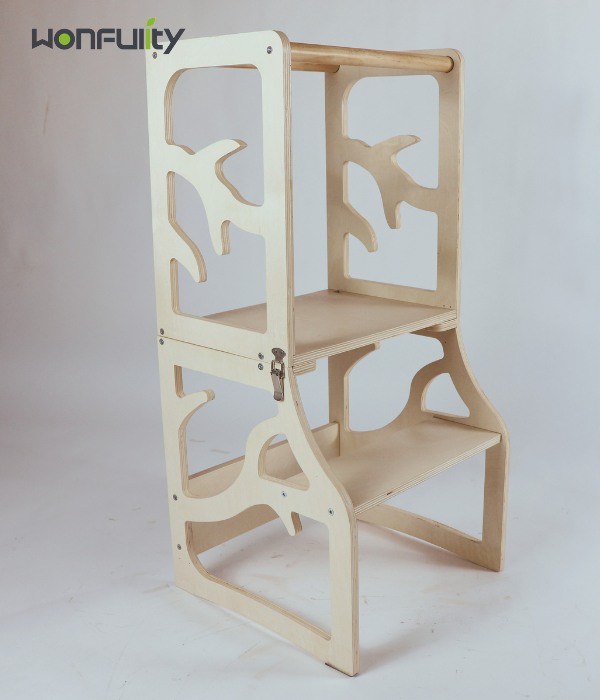
When a sample arrives, compare its dimensions and stability with the testing method required by the destination market. A loaded backpack and a casual sideways push are not substitutes for a formal tip or structural test. Ask for model-specific test evidence, and check whether the sample corresponds to the version you plan to sell.
Guardrails and gaps
Look at rail height relative to the platform and at every opening in the structure. Gaps should not be wide enough to trap a head or a limb, and the same goes for the space between the rails and the base. Wonfulity’s website says its children’s furniture follows North American safety standards, with rounded edges and non-toxic materials. That is a good starting point. Ask for the actual test reports for the model you pick, and for the standard they were tested against in your market, because a general statement is not a document you can show a retailer.
Folding and adjusting: where little fingers go
Moving parts are where learning towers get complicated. The tabouret de cuisine pliable folds flat for storage. The 2-in-1 tower with whiteboard converts into a table and chair. The adjustable tower with colourful panels has platform positions that move. Each of those features adds hinges, locks and pinch points.
Check that a folded or adjusted tower locks positively, and that a child cannot release the lock by accident. Look for places where fingers could be caught as parts move. Then do a simple test of your own: fold and unfold the sample fifty times, adjust the height at every position, and see whether it still sits firm. A wobble that appears after fifty cycles tells you more than a datasheet.
Wood, finish and hardware
The site lists solid wood, plywood and eco-friendly composite materials, and there is also a bamboo learning tower. Each behaves differently. Plywood edges need good sealing, because that is where moisture gets in. Solid wood can move with humidity. Bamboo is hard and stable, but the laminated structure and glue lines deserve a look.
Think about where the tower lives: next to a sink. Splashes and wet hands are part of its daily life, so ask about the finish and how it handles water and wiping. Rails also get chewed, which is why the website’s mention of non-toxic, eco-friendly paints matters, and why you should ask for the finish test report. Finally, look at the hardware. Screws should be recessed or covered, anything metal should resist rust, and the assembly design should make it hard to put a part in the wrong way.
What to put in your customisation brief
Wonfulity offers customisation of sizes, colours, logos, patterns and packaging. To get what you want, be specific. Send colour references, not words like “soft green”. Put logos where they will not weaken a joint or sit on a wearing surface. Agree on flat-pack packaging, including corner protection, a clearly labelled hardware bag and instructions that someone who has never seen the product can follow. Hand the first sample to a person outside your team, give them only the tools you ship, and watch how long assembly takes. That is how many safety problems are found.
For order planning, request the current MOQ, sample lead time and production schedule in the actual quotation. The website FAQ provides general figures, but design changes, packaging and order size can change them. Keep approved drawings, materials and safety-related requirements together in one revision-controlled brief.
One tower rarely makes a range
If you are building a Montessori range, a tower usually sells alongside other pieces. The step stools, kids tables and chairs et Montessori toys all share materials and finishing, which is useful when you want one consistent look. There is even a 4-in-1 kitchen stool with a chalkboard, and if chalkboards are a bigger part of your plans, a wooden chalkboard supplier that also makes towers saves you a second set of negotiations. See the chalkboard and easel range for the options.
For a first look at what is available, start with the custom learning towers category. When you have a design in mind, use the contact page to send a brief to the team at Wonfulity, a Montessori furniture manufacturer and wooden toys manufacturer in China.